One was Tyler Hamilton and Daniel Coyle's "The Secret Race".

The other one was "Bicycling Science 3rd edition" by David Wilson with Jim Papadopoulos.

"The Secret Race" is Tyler Hamilton's story of professional racing in the European grand tours, his involvement with doping and Lance Armstrong. It's an approachable and easy book written to appeal to cycling fans and released to pick up on the news interest in Armstrong's doping admissions and withdrawl from competition.
"Bicycling Science" is a very dense 476 pages, full of graphs, equations and diagrams, with notes and references, that just scratches the surface of the most obsessive obsessions of obsessive bike obsessives. It took a bit longer to read.
I've been reading and thinking and reading a bit more. I've learned quite a lot and I've come up with four big ideas that I'm going to try to explain here.
Bicycles are excellent for testing Human Physiology.
A bicycle is an excellent machine for transforming human muscular effort into smooth rotary motion which is easily used to drive machinery and easily measured and recorded. It can be adapted to different body sizes and shapes. It doesn't require any great gymnastic ability or highly complex skill for it's basic operation (although racing down hill in the rain is a different thing). The pattern of alternating effort and rest is said to closely match the optimum for human muscle function and it can be geared to suit different inputs and resistances.
Cycling is not a test of strength, it is a test of power. Not how much force can be applied but how fast energy can be produced and work can be done. "Bicycling Science" devotes 106 pages to discussing human power generation, including an interesting discussion about whether V02max (maximum rate of oxygen uptake), is as good a measurement of fitness as OBLA (onset of blood lactate accumulation). It then takes another 50 pages to explore the relationship between power and speed. But I think Luigi Cecchini, one of Tyler Hamilton's trainers quoted in "The Secret Race" sums up the human part of the cycling equation quite neatly.
"To win the Tour, you need only three qualities.
- You have to be very, very fit
- You have to be very, very skinny.
- You have to keep your hematocrit up."
The first two are products of innate physiology, training and diet. The third is where erythropoietin (EPO) and blood doping (collecting and re-infusing your own blood) come in. Interestingly, Hamilton maintains that prior to EPO, doping in cycling was not particularly advantageous. Steroids might increase strength and aid healing but they didn't really make riders "very, very fit". Amphetamines helped overcome fatigue, but clouded riders judgement and made them reckless. EPO and blood transfusions made such a difference that no one could win without using them... well that's what the guys who were using them keep telling us.
It's also interesting that with all those years of experience, and the help of a co author and presumably editors and fact checkers involved in publishing his book, Hamilton is still slightly unclear about exactly what EPO does. He describes it as stimulating the kidneys to produce more red blood cells. In fact EPO is a naturally occurring hormone which is produced in the kidneys and stimulates red blood cell production in the bone marrow. Not a serious inaccuracy, but interesting. Perhaps it illustrates that the guinea pigs are not the ones who are running the experiment.
Bicycles are difficult to stop, but they practically steer themselves.
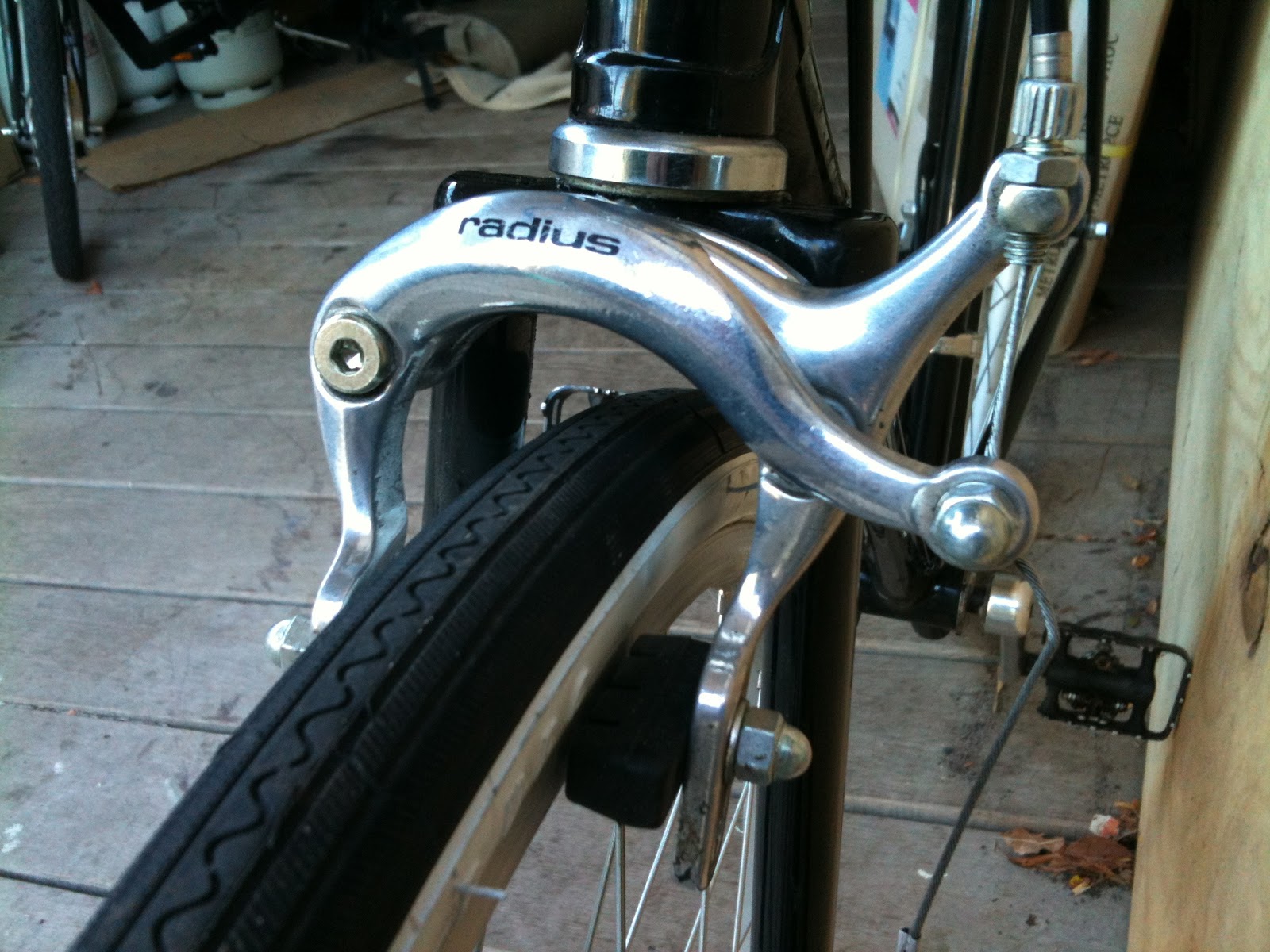
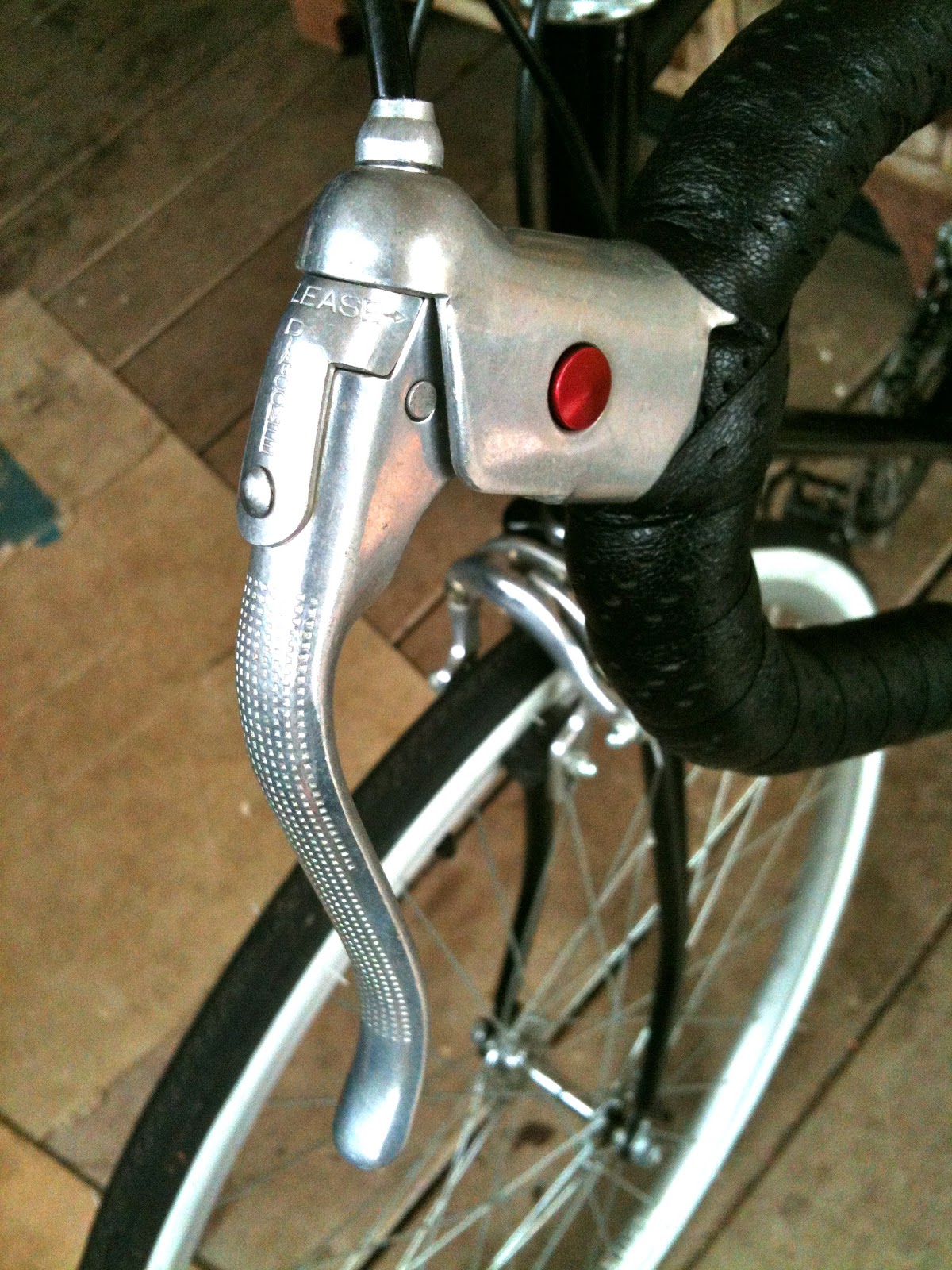
There are a bewildering array of different brakes on bicycles. Some will barely slow the bike down, some will lock up a wheel in an instant and possibly even rip it out of the forks. There are a bunch of difficulties in building a bicycle brake including heat dissipation through light weight components, problems of force transmission through cables and the frictional properties of materials.
I learnt that the coefficient of friction between steel wheel rims and rubber brake blocks can drop by over 90% in the wet, but with aluminium alloy rims the drop is only around 20%. This explains my childhood memory of frightening brake failure when riding my new ten-speed racer in the rain and why these days, even the cheapest bicycles have alloy rims.
But the real problem in stopping a bicycle is not stopping the wheels from rotating. The dynamics of the two wheeler mean that decelerating at more than about 0.5g (4.9m/s/s) tends to lift the rear wheel off the road making the machine uncontrollable. The authors of "Bicycling Science predict that a crouched rider will go over the handle bars or "take a header". On a mountain bike or BMX you can improve the situation somewhat by shifting your weight low and behind the saddle but the problem is still there.
In my days as an urban mountain bike rider, I lived at the bottom of Derby street, a steep hill with a tight right hand turn above a guard rail and a small cliff. Of course there were many ways to get down the hill including straight down with as little braking as possible. One wet day I got up too much speed and found that using the brakes did nothing at all to slow me down. My rear wheel lifted up and came around beside me, leaving me travelling side-ways down the hill, just as fast as I was going before. I tried this a couple of times before I realised that I was going to have to lie the bike down and hope the friction of skin on bitumen would be enough to stop me before the guard rail. If you have to do this you should put the bike down on the left to protect the drive train... I've still got the bike, but not the shorts I was wearing. I never ride without gloves, because I work with my hands.
Riding around with shonky brakes, or no brakes at all, seems to be part of the game for some cyclists. You should watch this video featuring New York cycle couriers in brakeless, fixed gear, check point races, through traffic. It shows some specialised fixed gear speed control techniques, including dropping the bike and running away, and just not stopping at all no matter what! It also covers some of the finer points of helmet cam technique.
If bicycle braking is ruled by clear and brutal physics, steering is a mystery in the realm of magic.
In most cases, a riderless bicycle, with some momentum, will tend to stay upright and continue on a straight or even curved course. If it leans to the left, the steering falls to the left taking the wheels back under the centre of gravity, righting the bike and putting it back on course. But..."Unfortunately, the mathematics purporting to describe bicycle motion and self-stability are difficult and have not been validated experimentally, so design guidance remains highly empirical."
Putting a rider on the bike just makes things even more complex, but I think this video illustrates that staying upright is mostly just a matter of keeping moving.
We all know that a touring bike is relaxed and stable, a road bike is fast and responsive, and a track bike is twitchy and aggressive in its handling. But nobody can say exactly what these things mean, or explain exactly how to design these properties into a bicycle.
There may be expert frame builders who can adjust trail, bottom bracket drop, chain stay length and stem size to give you a bike that handles just the way you want, but the "Bicycling Science" guys maintain that "Human observers are notoriously suggestible. When told that a given bicycle is special for some reason, they easily convince themselves that it is. ... in blind testing of bicycle characteristics, riders could not demonstrate anywhere near the powers of discrimination among alternatives that they claim to possess." They speculate "that many 'performance' sensations are imagined"!
The sudden occurrence of "steering shimmy" or "death wobbles" reminds me of the sort of state changes found in non-linear dynamics "chaos theory" or fluid physics, turbulent flow, two notoriously difficult areas where apparently simple deterministic systems can display unpredictable behaviour.
There are only three things slowing you down and only two together at any one time.
I'm quite interested in how to go fast.
On a smooth road, pedalling with constant power, there are three forces limiting your speed. Air resistance, slope resistance (gravity acting down hill) and rolling resistance.
Air resistance is pretty simple to understand. The faster you go, the harder the wind blows back on you. If you crouch down out of the wind, you can go a bit faster. I hate to admit it, but wearing tight fitting, lycra probably does make a difference to your potential top speed, at least compared to something like this...


Interestingly in a fully enclosed bicycle, or a stationary cycle, the loss of the cooling effect of air movement over the rider significantly reduces the maximum power output that can be achieved.
Air resistance is a very significant factor in limiting a cyclist's top speed, racers put a lot of effort into equipment and riding techniques that reduce aerodynamic drag, but it is only a significant force at high speeds.
At slow speeds, climbing hills, slope resistance is a more important limiting factor. This is also a pretty easy force to understand. It's gravity. The steeper the slope, the more it slows you down, and the heavier the bike and rider, the more power is needed to lift them up the hill.
Strangely, on a flat road, weight has no direct effect in limiting your top speed. It does effect acceleration, how quickly you can get to top speed, but once you get your momentum up, a heavy bike should go almost as fast on a flat track as a light one. (Weight does make a contribution as a determinante of rolling resistance.)
The other things that might hold your bicycle back, are energy losses in the drive train and resistance in the wheel bearings.
I was a bit disappointed, after all the time I spent cleaning, repacking and adjusting my wheel hubs, to find in "Bicycle Science" that "the drag of ordinary ball bearings is utterly negligible". Apparently, regardless of what they feel like when you turn the axle in your fingers, or spin the wheel in the air, under load, any reasonable quality ball bearing hub gives the same excellent performance. Expensive, high end hubs might look beautiful, they might weigh less, last longer and need less servicing and adjustment, but the won't actually make you go any faster at top speed.
Similarly, any reasonable pedal, crank and bottom bracket system will provide energy transfer so close to perfect, that any improvements make no real difference to performance..?

There might be some benefit from paying attention to the chain and gears. The best derailleur, chain transmissions may have efficiencies of over 99%, compared to average performances of only around 95% (wow a whole 4% difference!). A rusty chain, driving an internal geared hub might be only 85% efficient. But how much benefit is there from having a perfectly straight chain line on your fixe/single speed? "Negligible"!
That leaves rolling resistance, the resistance encountered by the wheel in contact with the road. This is all about road surfaces, wheel size and tyres..."rolling-resistance coefficients for smooth surfaces are widely accepted to range between 0.002 and 0.010, making the tires the second most important contributor, after air resistance, to the level-road drag acting on a bicycle". Reducing the coefficient by just 0.001 can increase top speed by up to 10%!
Tyres are the second most important thing for making a bike go fast! That's second after air resistance, if you're going fast, or weight if you're going up hill. But what makes the best tyre? That's a complex area full of compromises between performance and durability, empirical testing and trade secrets. Making good tyres and choosing the right tyres for the ride are mysterious arts.
While I was writing this post and thinking about how to go faster on a bicycle, I found out about Graham O'Bree. He has a diagnosis of bipolar disorder and has survived three suicide attempts. He also has two individual pursuit world championships and has broken the hour record twice. The International Cycling Union has twice changed it's rules to ban O'Bree's unorthodox riding positions and he's now making an attempt at the International Human Powered Vehicle Assosciation's land speed record, riding "The Beastie".

For Graham, it's all about aerodynamics, he's still perfecting the plastic fairing that will be sealed around him for the record attempt. The bike is made of steel, the drive train is complicated with multiple parts and the wheels are small (but with pumped up, narrow tyres). He doesn't have to ride up hill, so weight is not a big issue, he's gone for the smallest frontal area he can, tapering back to a drive system with "nothing between the ankles". As well as being aerodynamic, he believes he gets better bio-mechanical and cardio-respiratory performance in this position.
Brilliant!
Bicycles are disposable.
Bicycle frames and weight bearing components such as cranks and handlebars, don't usually break from a single high level of force that exceeds the "ultimate tensile strength" or "yield stress" of the materials they are made from. Nor do they break from "high-cycle fatigue" the accumulated effect of millions of small stresses repeated in normal riding. They break from "low cycle fatigue", failure occurring after a few, or a few thousand moderate to large stresses such as bumping off a curb, hard sprinting, or minor crashes. A standard bicycle might survive a few thousand such shocks, which could accumulate over a few decades or a few years depending on how it's ridden. You could build a bicycle that would last ten times as long, but it would weigh twice as much.
Practically every component of a bicycle faces this trade off between weight and durability. There are hundreds of parts in a bicycle and any one can break or wear out with normal use. Helpfully, most bicycles are built with fairly standard components, so parts can be easily replaced and even mixed and matched from different manufacturers, and the bike can be constantly repaired and renewed like "grandpa's axe". Less helpfully, there are more than a few different standards, often originating in different countries at different times, so your old italian frame may not fit a new japanese bottom bracket. There is also the contrary design strategy, where components are made with unique compatibilities and even requiring special tools to fit and adjust. This might be dictated by particular aspects of the design, but also as a marketing strategy, tying customers in to a particular brand.
Cycle racers need machines that will last for 300km of hard riding, but then the team mechanic can completely re-build the bike overnight. Many bikes will take years to travel that far, but might never be fully serviced again after they are built. These are very different situations and I often wonder if ordinary riders are getting a good deal when they buy "performance" bicycles. At least for some components "performance" might mean light weight, limited life-span and impossible to service or repair.
So.
I like riding the The Dark Horse, my rebuilt 1970's 10-speed. I like the big 27" wheels. It rides pretty nicely down hill and on the flats, but I've been riding with some mates on Sunday mornings and I keep getting left behind on the hills. So maybe I need a new bike...
Weight is important. The Dark Horse weighs an old school ton, but "Bicycling Science" tells me, adding 1kg (1-2% increase in overall mass) will only cut 30sec from an hour long climb. "Rarely enough difference to catapult a typical contestant onto the winner's podium ... only those who are already good enough to place in races have justification for weight shaving... (for) the vast majority of us ... a conventional 12-kg machine should serve well even in most competition."
It's worth noting that this book was published in 2004. It boldly states "The upshot of this discussion is that, compared to current (2003) sport bicycles, reduced weight or enhanced stiffness theoretically should offer virtually no performance advantage and may not even be detectable by the rider."
Today the UCI road racing rules set a minimum weight of 6.8kg as a safety measure... and a really fast bike looks like this...

That's the sort of aerodynamic styling you need to win a national time trial championship, but it's a bit extreme for a Sunday hack like me.
Being an average hack rider, I could probably loose more weight off my belly than my bicycle. 6.8kg is less than 10% of my body wieght.
I don't need the latest race-worthy components... Electronic shifters..? I'd rather have fairly sturdy stuff, that can be serviced and adjusted easily with standard tools.
What about this 1994 Trek 5500 UCLV carbon road bike with Shimano 600 'tricolor' groupset?

It was $4500 when it was new, now $650 on bikeexchange.com.au. It's probably got a few miles left in it if I don't ride it too hard and I can spend the money I've saved on some new tyres!